


Salt cells have quietly replaced buckets of chlorine tablets in most new Florida pools, and homeowners often assume the switch means less maintenance throughout the yard. That shift is especially common in South Florida, where salt systems have become the standard rather than the exception on new pool builds.
That assumption does not always hold up once splash-out starts reaching the edges of a backyard pool escape. Anyone weighing artificial grass pool surrounds next to a saltwater system should understand what the salt actually touches, and just as important, what it does not.
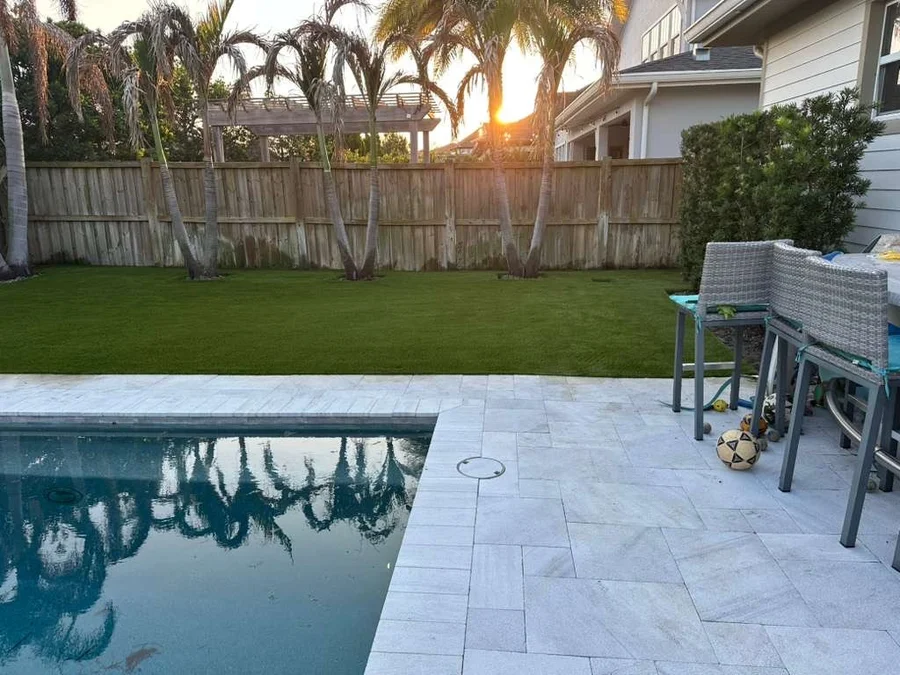
Where Salt Actually Ends Up After a Swim
A saltwater pool typically runs a salt concentration between 2,500 and 6,000 parts per million, close to the salinity of human tears, and salt chlorine generators convert that salt into chlorine through electrolysis rather than adding it directly. That process is outlined in the CDC's home pool water treatment guidance, and it explains why a saltwater pool is not actually chlorine-free.
Splash out, wind, and swimmers climbing out of the water carry trace amounts of that salty water a few feet onto the surrounding hardscape and landscaping, not the entire yard.
Why Synthetic Fibers Rarely Show Salt Damage
Polyethylene and nylon fibers used in today's synthetic lawns are largely inert to dissolved salt, unlike living grass, which can brown or thin when salt builds up in the root zone. This is one reason artificial grass pool surrounds tend to hold up better than sod planted the same distance from the water.
The color and texture also stay consistent season after season, since salt exposure does not fade or bleach the fibers the way it can discolor grout lines or nearby unsealed pavers. The fiber itself is not the weak point in a saltwater backyard, and it rarely needs replacement due to salt exposure alone.
The Real Risk Sits Below the Surface, Not on Top of It
The bigger threat to any backyard installation near saltwater is what happens underneath the fibers, not on top of them. A base that was not compacted correctly, a seam that was rushed, or a drainage system that cannot move splash out away from the turf fast enough will cause problems long before the salt itself does.
Our installation horror files page shows what a rushed job can look like a few years later, and most of those failures start below ground, not above it.
Common issues that show up first around saltwater pools include:
- Poorly compacted base material that traps water and brine near the seams
- Backing materials not rated for repeated wet and dry cycling
- Drainage that was undersized for the splash zone around the pool
- Edges near coping stones that were not sealed or pinned correctly
Infill and Drainage Choices Make the Difference
Choosing the right infill and drainage system matters more for artificial-grass pool surrounds than for a standard lawn. Our specialized infill options include cooling and antibacterial blends designed to handle extra moisture near a pool deck, and pairing them with a properly sized drain system keeps splash-out from lingering against the backing.
University of Florida researchers have documented synthetic turf runoff research showing how drainage performance affects surrounding soil, and those same principles apply directly to pool surrounds.
A properly built installation should also account for how the turf meets the pool deck itself. A professional installation process coordinates directly with local pool builders during a renovation or new build, so the transition between coping and turf sheds water as it should, rather than pooling at the edge.
It also means the drainage plan is tested against the pool's actual geometry rather than a generic yard layout.

Get Artificial Grass Pool Surrounds Built for Saltwater Systems
South Florida's mix of heat, humidity, and salt puts extra demands on anything installed within a few feet of a pool. Saltwater pools do not have to mean early wear on the landscaping around them, as long as the installation underneath is built for the job from day one.
Eternal Turf installs artificial grass pool surrounds designed around proper drainage, infill, and edging for Florida's saltwater pools. We are happy to walk through what that looks like for your backyard.
Contact us to schedule a free consultation and get a plan tailored to your pool, yard, and salt system.
View Our Recent Projects



At Eternal Turf, we’ve spent 25+ years perfecting the art of synthetic grass installation. Whether it’s a backyard, putting green, or pet-friendly space, we’re here to get it right. Contact us today and let’s create something built to last!